Indianapolis Scrap Yard Doubles Profit With Buyer Competitio
Most scrap yards in the Midwest have been running the same playbook for decades. One buyer. One phone call. One price — take it or leave it. For a mid-sized operation outside Indianapolis, Indiana, that playbook was quietly costing them money every single month. This is the story of how they changed it, what they learned, and why they'd never go back to the old way.
Note: The yard operator in this story has been anonymized at their request. All operational details are real; names and precise location have been changed.
---The Situation: A Busy Yard With a Pricing Problem
Mike runs a family-owned salvage and recycling yard about 20 miles southwest of downtown Indianapolis. He's been in the business for over 15 years — long enough to know the difference between a solid load of 304 stainless and a pile of mystery alloy, and long enough to know when he's leaving money on the table.
His yard processes a mix of industrial scrap: end-of-run manufacturing offcuts from nearby auto suppliers, non-ferrous loads from local contractors, and a steady volume of catalytic converters pulled from end-of-life vehicles. Business was good. Margins were not.
"We had two buyers we called. That's it," Mike told us. "One guy for cats and one broker for the non-ferrous. I figured the price was the price. You don't know what you don't know."
That changed in early 2026 when a fellow yard operator — someone Mike knew from a trade association meeting in Indiana — mentioned he'd been using a scrap metal auction online platform and was seeing real competition on his loads for the first time. Mike was skeptical. He'd seen tech platforms come and go. But he was also sitting on a significant backlog of catalytic converter cores and a growing pile of mixed copper he hadn't moved in six weeks.
He decided to give it a shot. He registered on SMASH Scrap — North America's B2B scrap metal auction platform and listed his first load the same week.
---The Process: Listing, Documentation, and Letting the Market Decide
Mike's first load was 47 catalytic converter cores — a mix of domestic and import units he'd been holding. His usual buyer had quoted him a flat rate the week before. Mike wasn't sure if it was fair. He had no reference point.
Setting up the listing took him about 30 minutes. He used SMASH's inventory tool to log each unit, ran VIN lookups on the vehicle-coded pieces, and used the serial tracking feature to document the higher-value converters separately. He shot photos of every tray and uploaded them directly to the listing.
"The photo documentation part — I didn't think it would matter. But the buyers actually asked about specific units based on the photos. They were reading the listing carefully. That told me these weren't tire-kicker buyers."
That's a key point. SMASH works with vetted buyers — recyclers, processors, and traders who are pre-screened before they can bid. These aren't random inquiries. They're industrial scrap metal buyers who know what they're looking at and are ready to move. That vetting process matters because it changes the quality of the bids, not just the quantity.
Once the listing went live, Mike watched bids come in over a 48-hour window. His usual buyer's flat rate was in the range — but it wasn't the top bid. Not by a meaningful margin. The auction format did what it's supposed to do: it revealed what the load was actually worth in a competitive market.
"I kept waiting for it to stop. It didn't. The bids just kept adjusting. By the time the auction closed, I had a number I felt good about."
Auto-invoicing handled the paperwork. BOLs and packing lists were generated through the platform. Mike didn't have to chase anything down.
---The Outcome: What Competition Actually Does to Scrap Metal Auction Prices
Mike isn't going to give us exact numbers, and we're not going to invent them. What he will say is this: the outcome on his catalytic converter load was better than his standing buyer's quote, and it was achieved without a single cold call or negotiation conversation.
"The thing that surprised me wasn't just the result on that first load. It was realizing that I had no idea what my loads were actually worth. I was just trusting one guy's number."
That's the fundamental problem with the one-buyer model. It's not that your buyer is dishonest. It's that without competition, there's no mechanism for price discovery. You don't know if you're getting a fair read on scrap metal prices today — you're just accepting someone else's version of it.
More buyers means better price discovery. That's not a marketing line — it's how markets work. When multiple vetted industrial scrap metal buyers compete for the same load, the price moves toward what the load is actually worth. That's the whole point of the auction format.
Mike went on to list three more loads over the following six weeks: a copper lot, a mixed aluminum run from a local manufacturer, and a second round of cats. Each listing followed the same process. Each attracted multiple bids from qualified buyers. He now treats the auction format as his default channel — not a backup.
If you want to understand how this compares to walking into your buyer's office with a load and a handshake, you need to explore the SMASH scrap metal marketplace to see how the bidding process actually works in practice.
---What Indianapolis Yard Operators Are Up Against in 2026
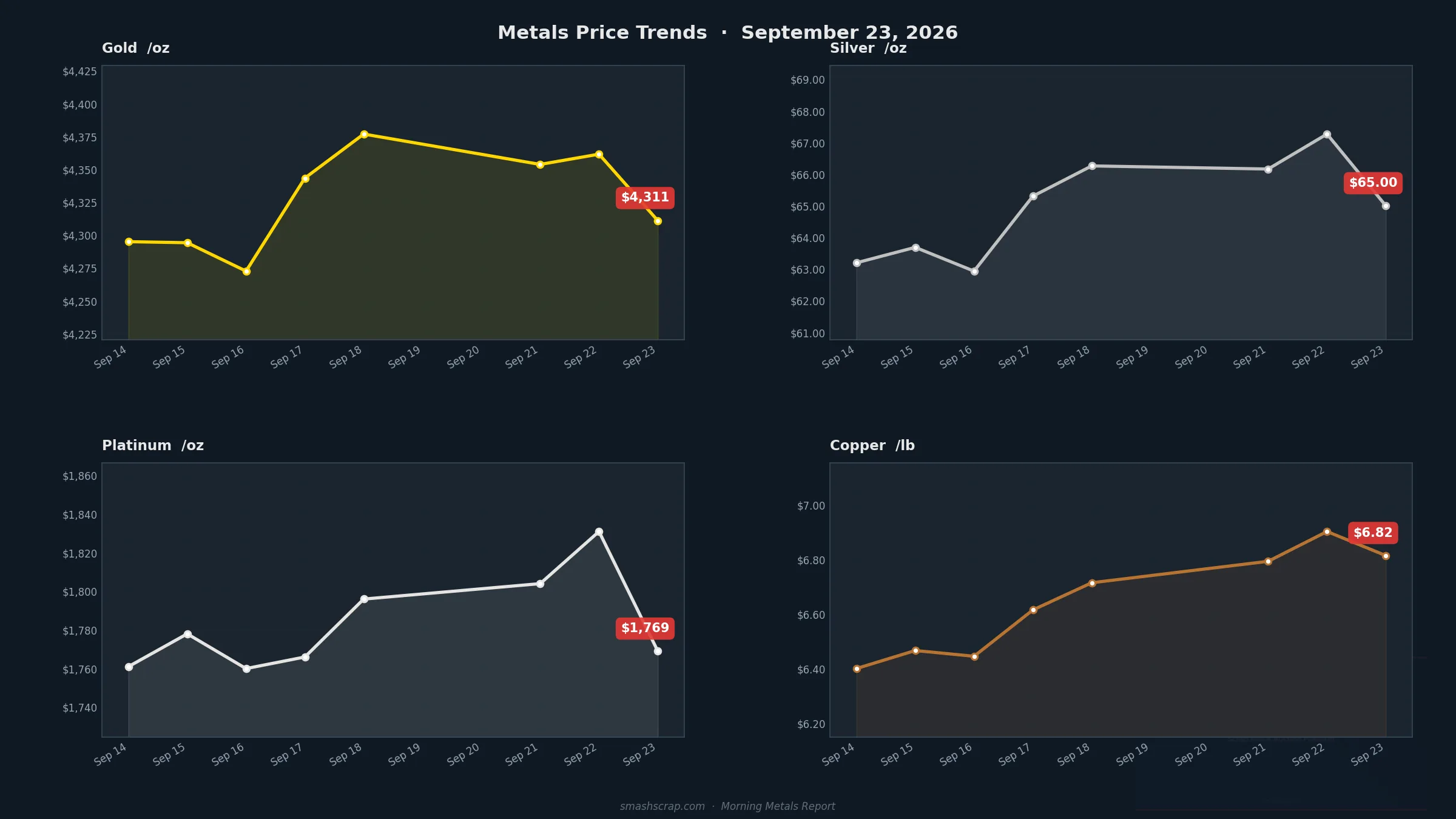
The broader market context matters here. In 2026, scrap processors across Indiana are dealing with tighter margins on ferrous, volatile non-ferrous pricing tied to global copper and aluminum moves, and increased buyer consolidation. When large processors and traders consolidate, individual yards often end up with fewer realistic buyers to call — which makes the single-buyer problem worse, not better.
Copper demand continues to be supported by AI infrastructure buildout, electrification, and ongoing supply constraints globally. That's a tailwind for yards holding non-ferrous. But you only capture that tailwind if your buyers are competing. One buyer quoting you on copper doesn't give you the market — it gives you their version of it.
Aluminum is in a similar position. Global supply deficits have pushed prices higher in 2026, and well-documented loads with clear alloy separation command stronger bids. That's exactly why SMASH's inventory documentation tools matter: buyers pay more when they know exactly what they're getting. Documented inventory gives buyers more confidence, and confidence drives bids up.
For yards near Indianapolis, the logistics picture is also relevant. The city sits at a major freight crossroads — access to I-65, I-70, and I-74 means loads can move efficiently to processors in multiple directions. That geographic reality makes Indianapolis yards attractive to a broader pool of buyers than operators might realize. The problem is most yards never test that assumption. They call their one buyer and assume that's the market.
For the latest analysis on what's driving metal prices and affecting recyclers right now, read the latest scrap industry news on the SMASH blog.
---What Mike Learned — And What It Means for Your Operation
Mike summarized his experience in a way that stuck with us:
"I thought I was running a tight operation. Good volume, clean loads, fast turnaround. I was doing everything right except the part where I actually found out what my scrap was worth."
That's the gap. Operational efficiency doesn't matter if your price discovery is broken. You can have the cleanest, best-documented, best-photographed load in Indiana — and if you're only showing it to one buyer, you're leaving the competitive market sitting on the table.
A few things Mike would tell other yard operators:
- Document everything before listing. Photos, serial numbers, VIN lookups on cats — buyers notice, and it affects bid quality.
- Don't assume your standing buyer is wrong. They might be fair. But you won't know until you test it against competition.
- The vetted buyer pool matters. Random inquiries waste your time. Qualified industrial buyers move loads.
- No subscription fees means no risk to list. SMASH only wins when you win. That alignment matters.
- Let the auction close before you decide anything. The first bid is never the final picture.
It's also worth noting: if you're handling end-of-life vehicles as part of your operation and need a reliable channel for scrap car removal, get free scrap car pickup across Canada through GetMyScrapCar — a trusted partner in the scrap vehicle space.
The SMASH scrap metal auction format isn't complicated. It's just a better version of the phone call you're already making — except instead of one buyer hearing your pitch, vetted buyers compete for your load on a transparent platform with full documentation behind it.
---Frequently Asked Questions
Q: How do industrial scrap metal buyers on SMASH differ from my regular broker?
SMASH buyers are pre-vetted before they can access or bid on listings. They're processors, traders, and recyclers who are actively looking for specific loads — not casual inquiries. The vetting process means you're dealing with serious buyers who have the capacity to move what you're selling.
Q: Are scrap metal auction prices on SMASH reflective of scrap metal prices today in my area?
Auction bids reflect what vetted buyers are willing to pay for your specific load at the time of listing. Because multiple buyers compete, the result tends to reflect real market conditions more accurately than a single-buyer quote. Prices fluctuate based on metal type, market conditions, and load quality — always verify current rates before listing.
Q: Can Indianapolis-area yards list any type of scrap, or is SMASH focused on specific materials?
SMASH handles a wide range of industrial recyclables — catalytic converters, non-ferrous metals, ferrous loads, cores, and more. If you're running a mixed yard in Indiana and processing industrial scrap, the platform is built to handle the variety and volume you're moving.
Q: Is there a subscription fee to sell on SMASH?
No. SMASH does not charge subscription fees. The platform operates on a model where SMASH only earns when a transaction happens — which means your interests and theirs are aligned from the start.
Q: How does photo documentation affect the bids I receive on scrap metal auctions online?
Significantly. Buyers bidding on loads they can't physically inspect rely heavily on photos, serial numbers, and documented inventory. A well-documented listing removes uncertainty — and buyers pay more when they're confident in what they're getting. SMASH's inventory tool is built specifically to make that documentation fast and structured.
---Ready to find out what your loads are actually worth? Stop guessing and start competing. Register for free and list your scrap today at smashscrap.com. Questions about selling? Email jeff@smashscrap.com directly.
Disclaimer: Scrap metal prices fluctuate based on market conditions, metal type, load quality, and buyer demand. Always verify current rates before finalizing any transaction.
Follow SMASH on LinkedIn for scrap market insights, industry updates, and platform news — because knowing what's moving the market is half the job.