Scrap Metal Markets Pause: What Sellers Need to Know Right Now
Metal Markets Take a Breather — But the Big Picture Hasn't Changed
If your scrap prices feel a little soft right now, you're not imagining it. Across precious metals, base metals, and industrial commodities, the market has shifted into a cautious, defensive tone over the past 30 days. But here's the key context every scrap seller needs to understand: this looks like a pause, not a collapse. The structural forces that drove metals to recent highs — AI infrastructure buildouts, electric vehicle adoption, green energy investment, and global geopolitical realignment — are all still very much in play.
Here's a breakdown of where things stand and, more importantly, what you should be doing about it.
Precious Metals: Correcting, Not Crashing
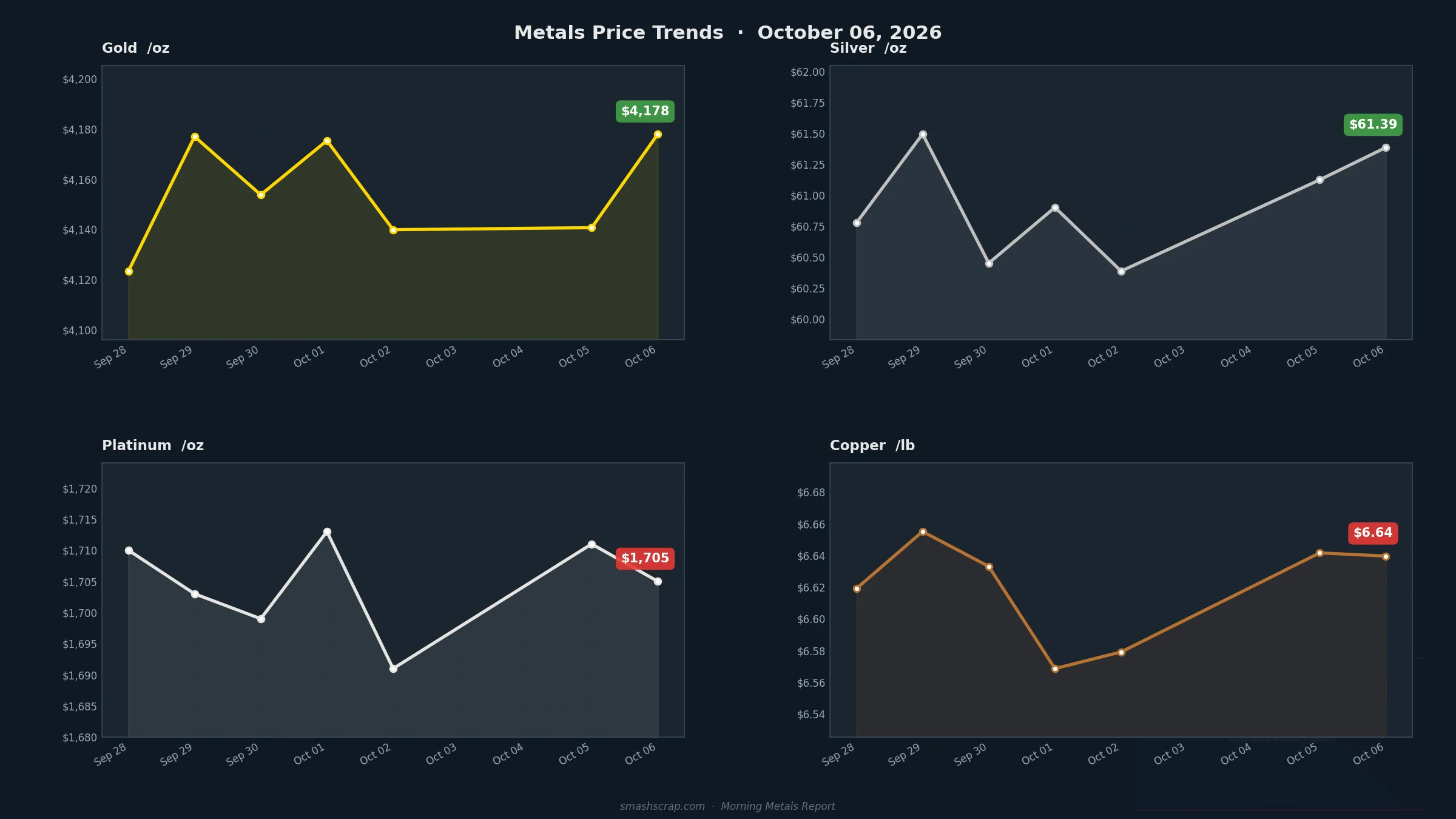
Gold Holds Above $4,000 Despite Pressure
Gold has pulled back 5.7% over the past 30 days, with spot currently sitting around $4,080 per ounce. The selling pressure comes from a firm U.S. dollar and higher real interest rates, which make non-yielding assets like gold less attractive to institutional investors in the short run.
That said, $4,080 is still historically exceptional territory. Large fiscal deficits and ongoing central bank diversification away from the U.S. dollar continue to support a bullish longer-term outlook for gold. For scrap dealers with steady flows of jewelry, e-scrap, or dental gold, this is not a moment to panic-sell. Maintain your normal inventory turns and, if your operation allows, consider spreading sales across several weeks to average through the volatility rather than dumping everything on a down day.
Silver Feeling the Pain
Silver is having a rougher ride, down 14.2% over 30 days to around $58.50 per ounce, with notable price swings along the way. Industrial demand from solar panels and electronics remains a genuine support, but it hasn't been enough to offset the pullback in investment flows. If you're buying silver scrap, tighten your buy spreads to protect your margins. If you're holding significant silver inventory, prioritize turnover over speculation right now.
Base Metals: Soft but Structurally Supported
The base metals complex is broadly weaker, though the moves vary considerably by metal:
- Copper (XCU): Down 3.9% — the most resilient of the group, and for good reason. Copper remains the backbone of electrification, and every new data center, EV charging station, and wind farm requires it. The dip here is modest relative to fundamentals.
- Aluminum (ALU): Down 12.4%, reflecting softening industrial demand and macro uncertainty. Watch for a potential floor as energy-intensive smelting economics limit supply-side responses.
- Nickel (NI): Down 11.9%, continuing its struggle with oversupply from Indonesian production. EV battery demand will be a long-term tailwind, but oversupply is the near-term reality.
- Zinc (ZNC): Bucking the trend with a modest +1.1% gain, showing quiet resilience in galvanizing and construction-related demand.
- Lead (LEAD): Down 7.7%, softening alongside broader industrial sentiment.
Ferrous Scrap: Steady as She Goes
Both Heavy Melt and Shredded Scrap are essentially flat over 30 days — a small silver lining in an otherwise mixed picture. Steel mill buying has been stable, keeping ferrous prices from sliding alongside the non-ferrous complex. This stability may not last if broader macroeconomic conditions deteriorate, which is worth keeping in mind as you plan your yard's selling schedule.
The Outlier: Rhodium Rises
In a sea of red, Rhodium (XRH) is up 3.1% — a reminder that the PGM complex, used heavily in catalytic converters, can move independently from broader market trends. If you're processing automotive catalytic converters, take note.
Key Takeaways
- Metal markets are broadly lower over 30 days, but most prices remain within recent historical ranges — this is a correction, not a breakdown.
- Gold is holding above $4,000; avoid panic selling at current levels, which remain historically strong.
- Silver is the most volatile precious metal right now — tighten buy spreads and focus on turnover.
- Ferrous scrap is flat and stable — a good window to move bulky, low-grade material before any potential macro-driven softening.
- Copper and zinc are outperforming the base metals complex; stagger non-ferrous sales rather than liquidating in one shot.
- The medium-term story — driven by AI, EVs, and green energy — remains structurally bullish for most metals.
What This Means for Scrap Sellers
The current environment calls for disciplined, strategic selling rather than reactive moves in either direction. For your ferrous inventory, stable prices and reliable mill demand make now a reasonable time to move volume, particularly lower-grade material that costs you space and handling. For high-value non-ferrous metals like copper, aluminum, and PGMs, a staggered approach — selling portions over several weeks — helps protect your average realized price against continued short-term volatility. Above all, don't let short-term noise distract you from the bigger picture: the demand fundamentals underpinning metal values haven't gone anywhere.
The sellers who come out ahead in markets like this are the ones who stay informed, move thoughtfully, and have access to a competitive buyer base. That's exactly where SmashScrap.com comes in. List your scrap inventory on SmashScrap.com today and put your material in front of verified, active buyers competing for your loads — so you capture the best available price no matter which direction the market moves next. Start your listing now at SmashScrap.com.