Scrap Metal Market Update: Correction Phase Creates Strategic Opportunities for Sellers
Scrap Metal Market Update: Navigating the Broad Correction Phase
If you've been watching metal prices lately and wondering what's going on, you're not alone. Across the board, we're seeing a broad correction phase — prices pulling back after strong runs, with sellers and buyers alike treading carefully. But here's the important context: the correction doesn't mean the story is over. Strong structural demand from AI infrastructure, electric vehicles, and renewable energy is still sitting firmly in the background. For scrap metal sellers, the key right now is knowing which metals to move, when to wait, and how to play the spread.
The Big Picture: Cautious Near-Term, Constructive Mid-Term
Macro forces are creating a push-pull dynamic across metal markets. On one hand, ongoing geopolitical tensions in the Middle East, elevated energy costs, and tight supply chains are fundamentally supportive for industrial and strategic metals. On the other, profit-taking by institutional investors and lingering fears about U.S. monetary policy — particularly the risk of rates staying higher for longer — are applying real downward pressure on near-term prices.
The practical takeaway for scrap sellers: industrial metals like copper, nickel, and platinum group metals (PGMs) are consolidating, not collapsing. Dips in these categories look more like temporary pauses than structural breakdowns. Precious metals like gold and silver, however, are showing weaker momentum and are likely to stay choppy in the weeks ahead.
Precious Metals: Gold Holds Ground, Silver Struggles
Gold — Defending the $4,000 Level
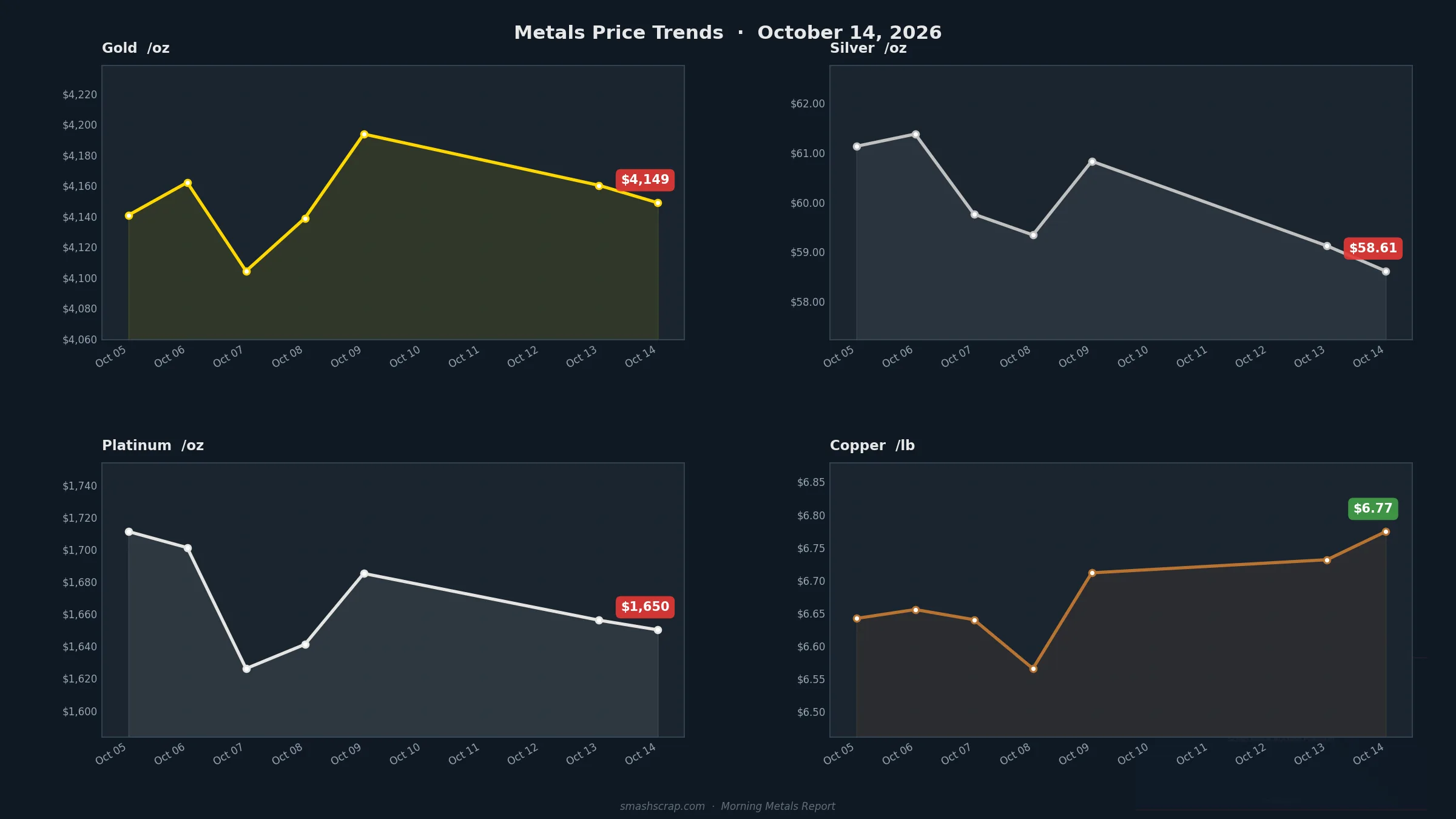
Gold is currently trading around $4,070.90/oz, down approximately 5.6% over the past 30 days, with short-term momentum still pointing lower. The metal has sold off roughly 10% from recent highs and is trading below key technical moving averages. That said, most analysts view this as consolidation rather than a breakdown — safe-haven demand and energy-driven uncertainty could easily bring buyers back if Federal Reserve expectations shift later in Q3 or Q4.
For sellers holding high-grade gold scrap — fine jewelry, dental gold, or bullion-grade material — expect buyers to be price-sensitive in the $4,000–$4,100 band. If you need liquidity now, auction it and accept tighter spreads. If you have flexibility, there's a reasonable case for waiting for better levels later this year. One word of caution: don't stockpile low-margin gold-bearing materials like e-scrap with heavy processing costs just to chase a potential 3–5% price rebound. Processing economics will eat your upside.
Silver — The Underperformer to Watch
Silver is the standout laggard right now, down a significant 16.0% over the past 30 days and carrying the highest volatility among major precious metals at around 6.4%. Short-term momentum sits at -2.04%, meaning the selling pressure hasn't fully exhausted itself. Despite strong structural demand from solar panels and electronics manufacturing, silver is being dragged lower by the same macro headwinds hitting gold — only harder. Sellers with silver scrap should expect a choppy, unpredictable near-term environment and plan their auction timing accordingly.
Industrial Metals: The More Interesting Story
While precious metals grab headlines, the real opportunity for scrap operators may be in industrial and strategic metals. Here's a quick rundown of the 30-day price trends:
- Copper (XCU): Down just 1.4% — the relative outperformer. EV and grid infrastructure demand keeps a floor under copper. Dips are worth watching as buying opportunities for processors.
- Nickel (NI): Down 5.9%, but long-term battery demand fundamentals remain intact. Patience is warranted.
- Aluminum (ALU): Down 6.7%, with energy cost pressures squeezing smelter margins globally — which could support scrap premiums.
- Lead (LEAD): Down 7.8%, the weakest of the base metals in this cycle.
- Zinc (ZNC): Bucking the trend with a +0.8% gain — a quiet outperformer worth noting.
- Rhodium (XRH): Up 1.2%, continuing to show resilience among the PGM group.
- Platinum (XPT): Down 6.7%, but autocatalyst and hydrogen fuel cell demand make this a mid-term recovery candidate.
- Palladium (XPD): Down 1.7%, holding up better than most precious metals.
Key Takeaways
- Metals are in a broad correction phase — this is consolidation, not collapse.
- Gold and silver face weak near-term momentum; sellers should accept realistic bid levels or wait for Q3/Q4 if possible.
- Copper, zinc, and rhodium are showing relative strength and deserve priority attention from sellers.
- Industrial metals remain underpinned by structural EV, AI, and renewable energy demand.
- Processing economics matter — don't chase small price moves with high-cost materials.
- Volatility creates opportunity: active auction platforms give sellers access to competitive bids even in choppy markets.
What This Means for Scrap Sellers
In a correction market, timing and access to buyers matter more than ever. Scrap yard operators who rely on a single buyer or spot quotes from local dealers are likely leaving money on the table right now. Competitive bidding environments allow you to capture fair market value even when price momentum is uncertain — and they give you real-time price discovery so you can make informed decisions about when to hold and when to move material. For copper and zinc scrap in particular, now is a reasonable time to bring material to market given their relative strength. For gold and silver, assess your carrying costs honestly before deciding to wait out the correction.
Ready to put your scrap in front of verified industrial buyers across North America? List your material on SmashScrap.com today and let competitive bidding work in your favor — regardless of where the market heads next. Our platform gives scrap sellers transparent, real-time access to serious buyers for ferrous, non-ferrous, and precious metal scrap. Sign up or list your first lot free and see the difference a competitive auction makes to your bottom line.