2026-11-18 — Scrap Metal Market Update: Pressure Across Precious & Industrial Metals
Scrap Metal Prices Under Pressure — What Sellers Need to Know Right Now
If you've been watching the scrap market lately, you already know it's been a rough stretch. Precious metals are sliding, copper has taken a significant hit, and the broader market is sending a clear message: now is the time to move material, not hold it. Here's a breakdown of where prices stand, what's driving the declines, and what smart scrap sellers should be doing about it.
Market Snapshot: Where Prices Stand Today
The selloff is broad-based, hitting precious and industrial metals alike. Here's a quick look at current pricing and recent trends:
Precious Metals
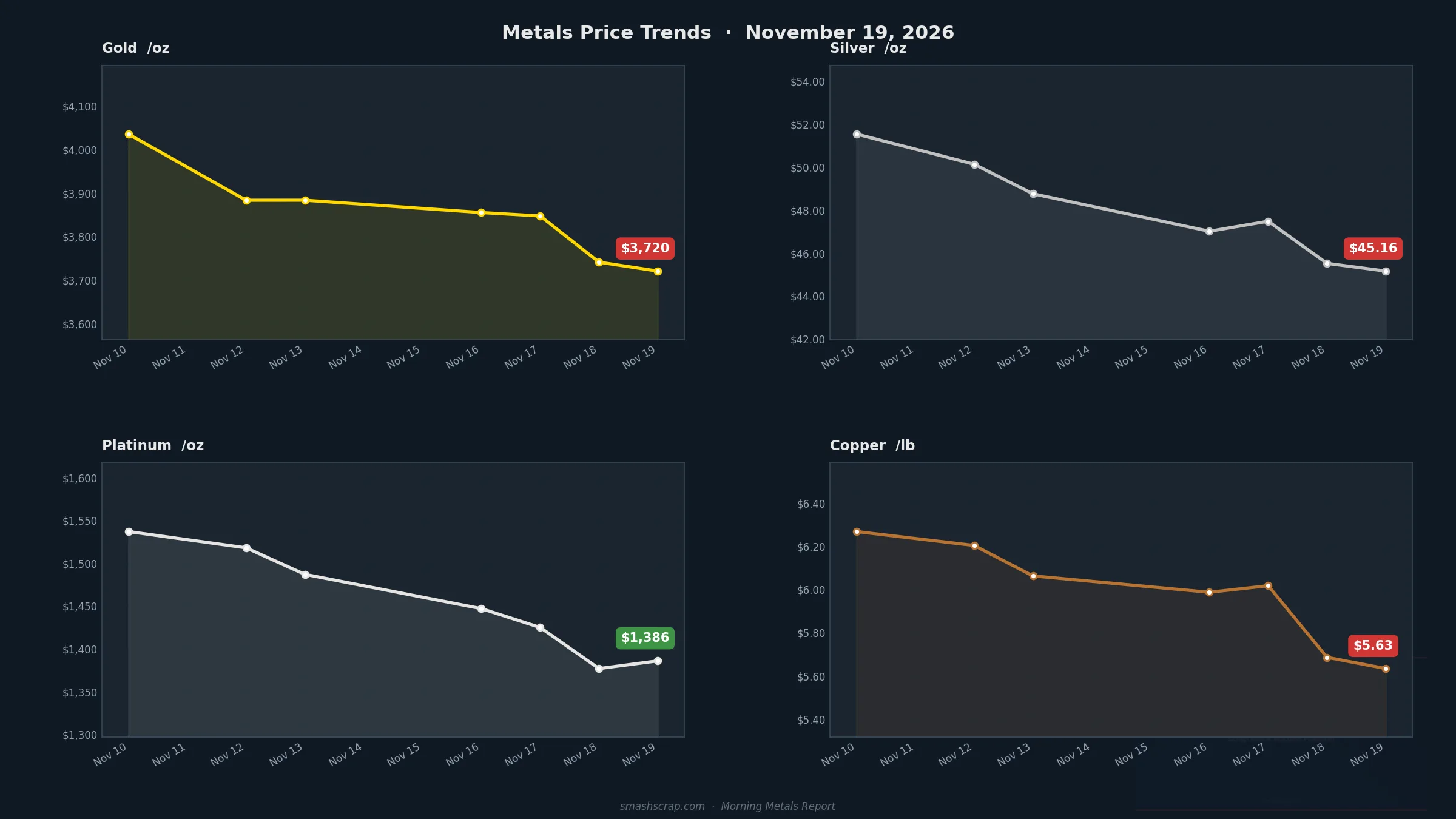
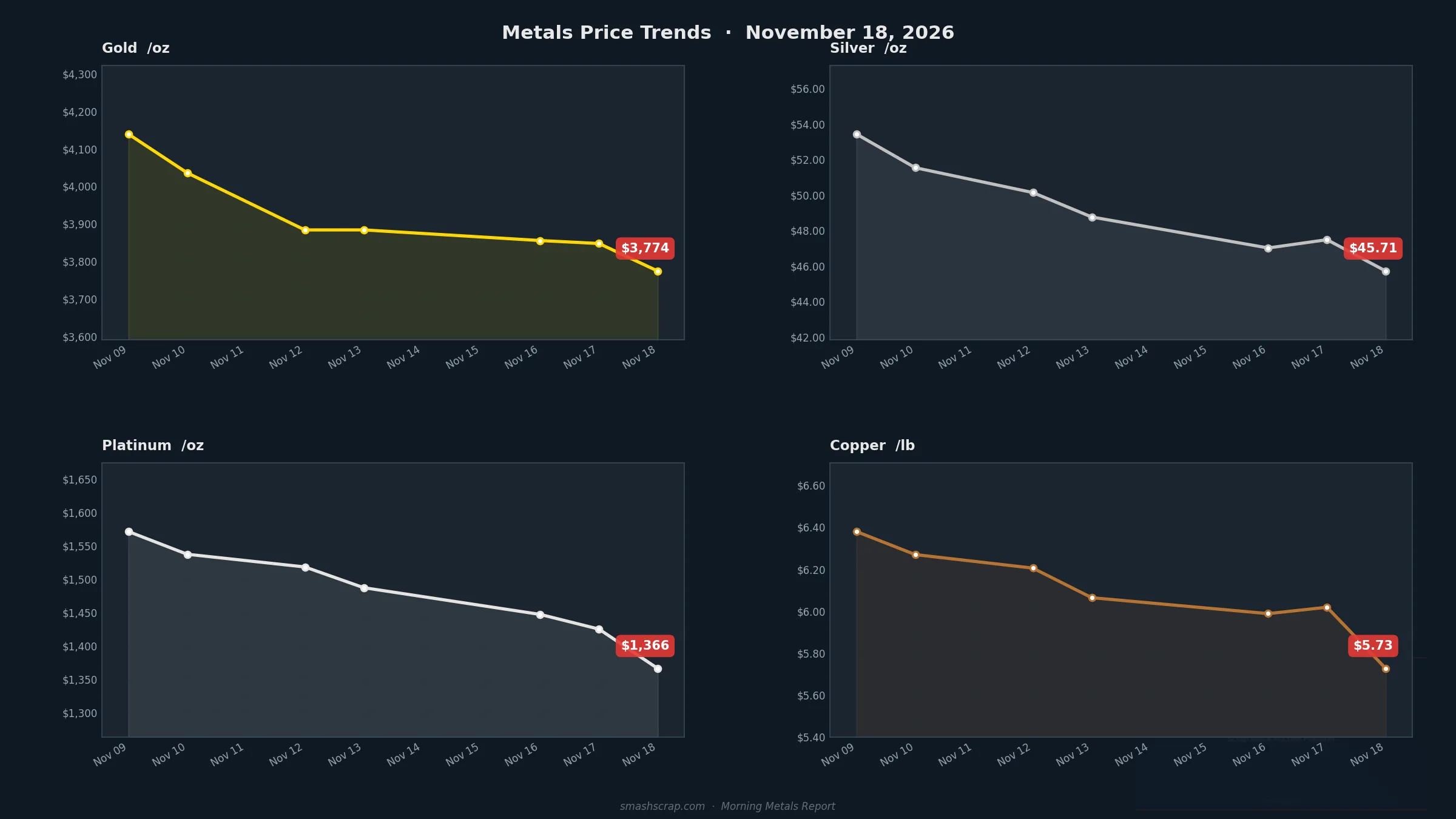
- Gold: $3,782.90/oz — down 8.5% over the past 30 days, with five-day momentum still negative at -2.59%.
- Silver: $45.79/oz — the weakest major precious metal right now, down a steep 19.6% over 30 days and another 8.67% in just the past five days. High volatility makes this one especially risky to hold.
- Platinum: Down 15.9% over 30 days, with strong short-term selling pressure continuing.
- Palladium: Down 14.6%, also facing heavy near-term headwinds.
Industrial Metals
- Copper: $5.72/lb — down 13.1% in 30 days and 7.86% over the past five days. One of the harder-hit industrial metals in the current environment.
- Aluminum: $1.30/lb — down 5.4%, but showing lower volatility than copper. A relatively calmer decline.
- Nickel: The standout performer, up 4.1% over 30 days, though five-day momentum has turned slightly negative — worth watching.
- Lead and Zinc: Essentially flat, with modest negative short-term momentum. Stable for now.
- Steel and Shredded Scrap: Holding steady at $366/mt and $413/mt respectively. The flatness here reflects a negotiated, relationship-driven market rather than any bullish momentum.
What's Driving the Decline?
The pressure isn't coming from one single source — it's a combination of macroeconomic forces hitting the market from multiple directions.
A stronger U.S. dollar is the primary culprit for precious metals. Since metals are priced in dollars globally, a rising dollar makes them more expensive for international buyers and tends to push prices down. Add to that growing expectations for additional Federal Reserve rate hikes, and you have a tough environment for gold, silver, platinum, and palladium. Higher interest rates also increase the cost of carrying inventory, which reduces the appeal of holding non-yielding metals.
For industrial metals like copper, the problem is more about demand. Concerns over Chinese manufacturing slowdowns, softer global economic activity, and uncertainty around future infrastructure spending have all weighed on futures prices. That said, there is a nuance worth noting: tight physical supply in China is supporting spot premiums in some markets, which means weaker futures prices don't always translate directly to every physical transaction. Local conditions still matter.
Platinum has a genuinely positive long-term story — analysts expect a future supply deficit — but that longer-term outlook is being completely overshadowed right now by dollar strength and investor liquidation. Don't let the fundamentals fool you into holding too long in this environment.
Key Takeaways
- Silver is the most urgent situation. With a nearly 20% drop in 30 days and ongoing high volatility, silver-bearing material carries real holding risk.
- Precious metals need frequent repricing. Gold, platinum, palladium, and rhodium values are shifting fast — lots priced even a few days ago may already be mispriced.
- Copper losses are significant. A 13% drop in a month is material for high-volume copper sellers. Shorter holding periods protect margin.
- Nickel is the exception. It's the only major metal showing a positive 30-day trend, though watch the short-term momentum carefully.
- Steel and shredded scrap remain stable — no windfall, but no freefall either. A reliable baseline for ferrous operations.
- Grade separation matters more than ever. When markets are falling, mixing higher-value grades into bulk loads means leaving money on the table. Sort carefully before listing.
What This Means for Scrap Sellers
In a falling market, the worst thing you can do is wait and hope for a quick rebound. Prioritizing cash flow over speculation is the right move right now. That means shortening your holding periods, getting material to market faster, and making sure you're separating higher-value grades — especially precious metal-bearing scrap — rather than bulk-pricing everything together.
For precious metals in particular, repricing frequently isn't optional — it's essential. A lot priced on Monday may need to be adjusted by Thursday. Buyers are watching these markets closely, and so should you.
For ferrous material and steel scrap, the flat market actually offers a degree of predictability. Use that stability to your advantage by moving volume steadily rather than trying to time a pop that isn't showing up in the data.
The scrap yards and dealers who come out of a down cycle in the strongest position are typically those who kept inventory moving, priced accurately, and didn't let declining material sit while waiting for better days that may be months away.
List Your Material on SmashScrap.com Today
In a market like this one, reaching the right buyers quickly makes all the difference. SmashScrap.com connects scrap sellers directly with serious B2B buyers across the country, giving you a competitive, transparent auction environment to move material efficiently — whether it's copper, aluminum, precious-metal scrap, or ferrous loads. Don't let falling prices erode your margins while material sits in the yard. List your scrap on SmashScrap.com today and put your inventory in front of motivated buyers who are ready to act.