
Memphis Scrap Metal Auction Online | June 28 Update
Week Ending June 28, 2026: Scrap Metal Market Recap for U.S. Yards and Buyers
If you ran a yard this week, you felt it. Base metals softened slightly heading into the weekend. Ferrous benchmarks stayed murky. And a billion-dollar steel expansion story out of Arkansas reminded everyone that domestic mill appetite for scrap isn't going anywhere. Here's what moved the needle in the scrap metal auction online world this week — and what Memphis-area yards should be watching heading into July.
This recap pulls from live commodity data, industry news, and RSS feeds through June 28, 2026. No invented price levels. No guesswork dressed up as analysis. Just the signals worth tracking.
Non-Ferrous Softens Into the Weekend — What It Means for Your Scrap Offers
Copper, nickel, and aluminum all posted small negative daily changes on June 27. We're not talking a collapse — but the direction matters. When primary base metals drift lower, mill buyers and non-ferrous dealers typically walk back their buying ideas on scrap. Spreads between primary and scrap widen. Offers cool. If you were expecting last week's numbers to hold through the weekend, they may not.
The copper pullback is the one to watch most closely. Copper-bearing material — wire, birch/cliff, #1 and #2 copper — often prices tightly to Comex and LME movements. A half-percent slip in primary copper doesn't sound like much, but across a large load it moves the needle. Same story for aluminum and nickel-bearing stainless. Buyers working those grades will adjust accordingly.
What does this mean practically? If you're sitting on non-ferrous inventory heading into the July 4th holiday week, you're in price-discovery territory. The old way — calling one buyer and hoping their number is fair — leaves you flying blind right now. SMASH Scrap — North America's B2B scrap metal auction platform puts your load in front of vetted industrial scrap metal buyers competing for it. That competition is how you find the actual market, not just one buyer's idea of it.
$1.1 Billion Steel Mill Expansion in Arkansas — What Scrap Yards Need to Know
The headline of the week in the ferrous world: an Osceola, Arkansas steel company announced plans to build a second rebar mill in a $1.1 billion expansion. The project is expected to roughly double output at the facility. Resource Recycling covered it. K8 News in Jonesboro had it too. This is real infrastructure, not a press release.
Why does this matter to yards in Memphis and across the Mid-South? Because electric arc furnace (EAF) rebar mills run on scrap. That's the feedstock. A new rebar mill at that scale is a long-term demand signal for ferrous scrap in the region — shredded, HMS, busheling, you name it. It won't move Monday's buying price, but it's a structural tailwind for anyone selling iron scrap in this geography over the next several years.
The Mid-South scrap corridor — Memphis down through the Delta and up into the Arkansas and Missouri river counties — sits within economic trucking distance of that Osceola facility. If you're a yard operator thinking about where regional demand is heading, this expansion is a data point worth filing away. More domestic EAF capacity means more competition for the same domestic scrap supply.
- Project size: $1.1 billion expansion
- Output impact: Approximately doubles current rebar production
- Feedstock: Ferrous scrap — shredded, HMS, and related grades
- Regional relevance: Osceola is approximately 70 miles north of Memphis via I-55
- Long-term signal: Domestic EAF growth = sustained regional scrap demand
If you want to explore the SMASH scrap metal marketplace and see how vetted buyers across the region are pricing ferrous loads right now, this is the week to do it. More buyers means better price discovery — especially in a market where structural demand signals like this one are building.
Chinese Brokerages Eye LME Membership — A Long-Term Watch Item for Scrap Flows
Reuters broke a story on June 26: Chinese brokerages are pushing for London Metal Exchange (LME) membership to expand their global metals role. This is a strategic play, not a tomorrow-morning market mover. But for anyone tracking the export-side of the scrap market, it's worth understanding what it signals.
Chinese participation in LME price discovery — if it expands — could affect how benchmark prices for non-ferrous metals are set globally. That flows downstream into scrap values. Chinese import appetite for copper scrap, aluminum scrap, and other non-ferrous grades has historically been one of the biggest external drivers of U.S. export scrap prices. Any structural change in how Chinese trading houses access global metals markets is worth tracking over the next 12-18 months.
This is also a reminder that scrap isn't a local business anymore. A yard in Tennessee selling copper-bearing material is operating in a global market — even if it doesn't feel that way when you're taking a phone call from one buyer. That's exactly the gap a scrap metal auction online platform closes. More market exposure. Less dependence on one buyer's agenda.
Catalytic Converter Market: No Major Price Event This Week, But Stay Disciplined
No major catalytic converter pricing news broke this week from the feeds we tracked. That's not surprising — cat prices have been volatile through 2026, driven by PGM (platinum group metal) movements and ongoing regulatory pressure around converter theft documentation and chain-of-custody requirements.
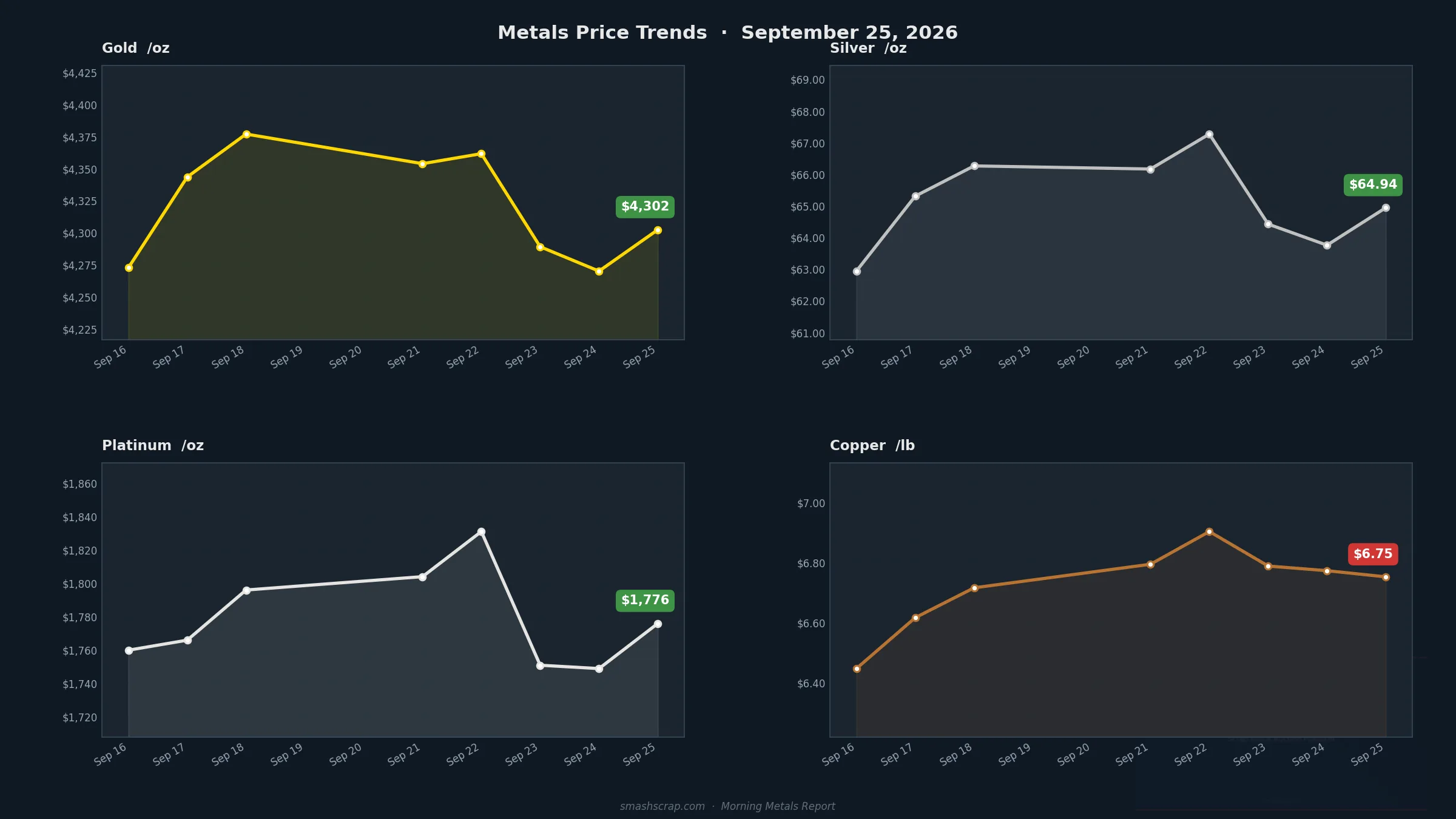
What we did see: gold touched the $4,000 level this week with significant volatility, and silver stayed below $60. PGMs don't move in lockstep with gold, but precious metal sentiment affects the broader atmosphere around converter values. When gold swings hard in either direction, buyers start reassessing PGM-adjacent positions.
For yards handling cats — whether it's a full load of cores, OEM pulls, or aftermarket converters — documentation has never mattered more. Serial tracking, photo documentation, and proper chain-of-custody records aren't just regulatory boxes to check. They build buyer confidence and can directly affect what you get paid. A catalytic converter auction on a platform that supports photo documentation and serial tracking gives buyers the confidence to bid stronger. That's how documented inventory translates into better price discovery.
If you're selling cats and relying on one phone call to set your price, you're leaving money on the table — and taking on unnecessary compliance risk. The documented, auctioned approach exists. Use it. And if you're moving end-of-life vehicles connected to cat recovery, get free scrap car pickup across Canada is worth knowing about for cross-border operations and fleet recycling programs that touch both sides of the border.
What to Watch the Week of June 30 — July 4, 2026
Holiday weeks are tricky in scrap. Volumes tend to drop. Some buyers go quiet. But the yards that use the downtime to get their inventory documented, photographed, and listed are the ones that hit the ground running when buyers come back strong the following week. Here's what to track:
- Copper and non-ferrous direction: Watch LME and Comex copper through Monday and Tuesday. If the slight softness from June 27 continues, expect non-ferrous scrap buying ideas to stay subdued through the holiday. A rebound would shift that quickly.
- Ferrous scrap benchmark prints: LME Steel Scrap CFR Turkey and CFR Taiwan contracts are active. The direction of those prints heading into the holiday week will tell you where export-side ferrous demand is tracking.
- Arkansas rebar mill updates: Watch for any permitting or timeline news out of the Osceola expansion. If groundbreaking timelines accelerate, regional scrap demand signals will sharpen.
- PGM sentiment: With gold volatile at the $4,000 level, watch for any movement in platinum and palladium — the two PGMs most directly tied to catalytic converter values. Any significant move either direction will ripple into cat pricing quickly.
- Holiday-week buyer activity: If you're listing scrap on SMASH scrap, holiday weeks can actually surface buyers who are actively looking for deals while competition from other sellers dips. Less listing volume doesn't always mean lower prices — especially when vetted buyers are still active.
For the latest on what's moving in the scrap sector, read the latest scrap industry news on the SMASH blog. We track the signals that matter to yard operators and buyers — not commodity desk noise designed for hedge funds.
Memphis Yards: The Regional Picture Heading Into July
Memphis sits at a crossroads — literally and commercially. The Mississippi River corridor, I-55, I-40, and the rail infrastructure through Shelby County make it one of the most logistically connected scrap markets in the country. That matters when you're trying to move volume efficiently.
With a major EAF rebar mill expansion underway 70 miles north in Osceola, and ongoing demand from Tennessee and Mississippi-based processors, Memphis-area yards are in a decent structural position. The challenge, as always, is price discovery. One buyer calling you on a Tuesday afternoon is not a market. It's one data point — and often a self-interested one.
The scrap metal auction Tennessee and Mid-South market is competitive enough that you should be getting multiple bids on every significant load. That's what a scrap metal auction online format delivers. Whether you're moving shredded steel, #1 copper, aluminum clips, or a load of cats, the auction format exists because competition finds the price faster than a phone call ever will.
Sell iron scrap online. Auction your cats. Get your non-ferrous loads documented and in front of buyers before the holiday week ends. That's the move.
Frequently Asked Questions
Q: How does a scrap metal auction online work for a yard in Memphis?
You document your load — grades, weights, photos, any relevant serial or VIN data — and list it on the SMASH platform. Vetted industrial scrap metal buyers across North America can then bid competitively. The auction format replaces the single-buyer phone call with actual market competition, which helps reveal the real price for your material.
Q: Is there a subscription fee to sell scrap on SMASH?
No subscription fees. SMASH only wins when the seller wins. You don't pay to list — the platform earns when a transaction closes. That aligns our incentives with yours.
Q: How do catalytic converter auctions work on SMASH?
Sellers document their cat load with photos, serial numbers, and grade details. Vetted buyers — who have been screened by the platform — bid on the load. Documentation builds buyer confidence, which supports stronger bids. It also supports chain-of-custody compliance, which matters more than ever in the current regulatory environment.
Q: Does the Arkansas steel mill expansion affect scrap prices in Tennessee?
Not immediately — but it's a structural demand signal. A new EAF rebar mill at that scale needs scrap as feedstock. Over time, increased domestic mill capacity in the region tends to support ferrous scrap demand and can tighten local supply, which benefits sellers. Memphis-area yards are geographically well-positioned relative to that facility.
Q: Why do non-ferrous scrap prices move when primary metal prices change?
Scrap is a raw material input for primary metals production. When LME or Comex copper drops, for example, buyers of copper scrap typically lower their bids because the processed output is worth less. The pass-through isn't always immediate or one-to-one, but directional alignment between primary and scrap prices is the norm — especially for high-purity grades like #1 copper or zorba.
List your scrap on SMASH today — register for free at smashscrap.com. No subscription. No guessing. Just buyers competing for your loads.
Follow SMASH on LinkedIn for weekly scrap market insights, platform updates, and industry news: SMASH on LinkedIn.