Toledo Scrap Metal Week: Tariffs & Trade Impact
Toledo Scrap Market Recap — Week Ending July 12, 2026
If you're trying to get the best price for scrap metal in Toledo right now, this week handed you a mixed bag. Trade tensions, gold's ongoing identity crisis, a new safety law for yards, and macro signals worth watching — it was a busy seven days in the metals world. Here's what moved, what matters, and what to watch heading into next week.
Before we get into it: every week, yards and recyclers across Ohio are leaving money on the table by calling one buyer and taking whatever price they're offered. That's the old way. SMASH Scrap — North America's B2B scrap metal auction platform exists to end that habit. More on that below. Let's get into the week.
1. Trade Policy: India–US Tariff Friction Adds Ferrous Uncertainty
The biggest macro story affecting metals this week wasn't a supply shock — it was paperwork and politics. India formally challenged the U.S. Trade Representative's Section 301 tariff determination, arguing the methodology doesn't adequately justify grouping multiple economies together under the same tariff umbrella. New Delhi is pushing for bilateral negotiations, not escalation — but the uncertainty is real.
Why does an India–US trade dispute matter if you're running a yard in Toledo, Ohio? Because Section 301 measures influence tariffs on metal-containing goods and intermediate inputs. When trade flows shift — even across secondary and recycled material categories — it ripples through regional ferrous and non-ferrous scrap demand. Continued ambiguity around future tariff structures means buyers and sellers both face a harder time pricing forward. Competition between buyers, not guesswork, is how you navigate that. That's exactly what a scrap metal auction online format is built for.
Separately, India unveiled a roadmap for duty concessions on vehicle imports under the India–UK trade agreement. This is mostly a finished-vehicle story, but indirect implications for auto steel and aluminum recycling flows are worth tracking, especially for yards that move a lot of shredder feedstock or auto body material.
2. Anti-Dumping Extension: Steel Tube Duties Hold Through January 2027
India extended anti-dumping duties on seamless steel tubes and pipes until January 2027. This keeps pressure off domestic mills in those segments and sustains melt demand — particularly for EAF-based producers who rely on scrap as their primary feedstock. It's a quiet but meaningful signal: domestic ferrous scrap demand in that market isn't collapsing anytime soon, and mills with regional protection tend to stay active buyers.
For Toledo-area yards, this is a longer-game indicator. Strong domestic demand signals in key steel-producing economies support the logic of getting your scrap in front of as many vetted buyers as possible, not just your local contact. When mills are protecting margin and staying in the market, competition for quality material intensifies. Documented loads — with photos, weights, and accurate descriptions — give buyers more confidence to bid higher. That's where scrap metal inventory management stops being an administrative task and starts being a revenue tool. Explore the SMASH scrap metal marketplace to see how documented inventory drives better buyer engagement.
3. Gold's Rough Quarter — and What It Signals for Base Metals
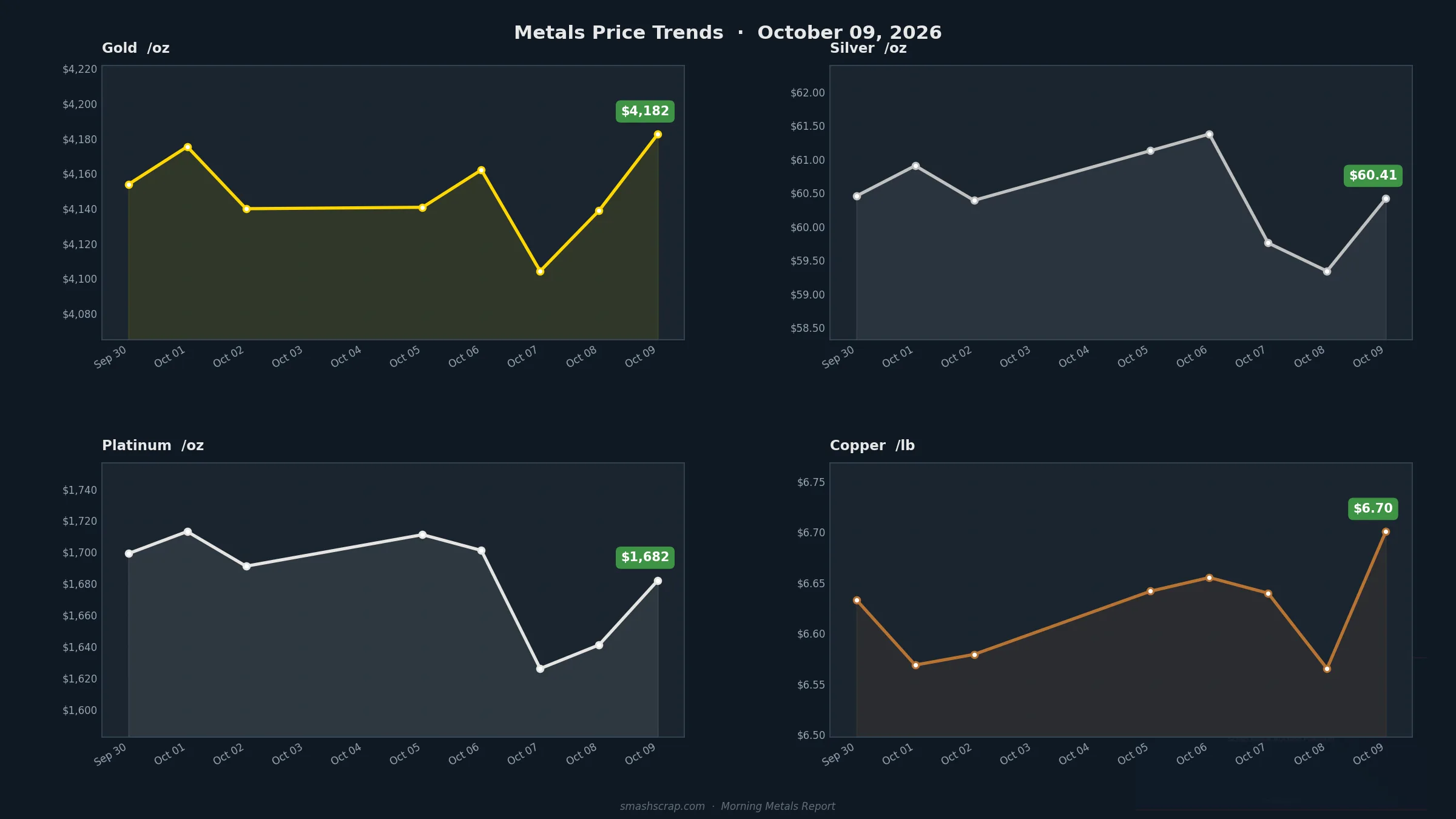
Gold held above $4,100 this week, but don't let that number fool you — the precious metals picture is choppy. The world's 50 biggest mining companies shed $228 billion in market cap during Q2 2026. Wall Street and Main Street sentiment diverged sharply, with institutional traders cautious and retail buyers still bullish. StoneX's Q3 outlook puts gold finishing the year near $4,000/oz and silver in the $55–60/oz range.
Hormuz tension and yield pressure on silver kept that market volatile. Central banks continued adding gold to balance sheets — a longer-term bullish signal — but near-term selling pressure isn't gone. Gold and mining equity weakness in Q2 often foreshadows tighter credit conditions and risk-off behavior in base metals. For scrap yards, this translates to one message: don't assume non-ferrous prices hold at current levels indefinitely. Lock in good prices when buyers are competing for your material. Don't wait for a ceiling that may already be behind you.
If you're sitting on copper, aluminum, or other non-ferrous inventory and wondering who buys and picks up scrap metal at competitive rates, the answer isn't your one regular buyer — it's a verified network of buyers in an auction format. That's what SMASH is built to deliver. You can also read the latest scrap industry news on the SMASH blog for ongoing market context between weekly recaps.
4. New Jersey Safety Law — A Preview of What's Coming to More States
New Jersey moved this week to codify fire safety requirements specifically for scrap metal businesses. The law targets fire risk within yard operations — a real and underappreciated liability in this industry, where mixed loads, lithium-ion batteries embedded in e-scrap, and compressed gas cylinders create ignition hazards that most general commercial fire codes weren't written for.
Ohio yards should pay attention. New Jersey is frequently a bellwether for regulatory direction across the Northeast and Midwest. When one state codifies industry-specific safety rules, others follow — sometimes quickly. Here's what smart operators should be thinking about right now:
- Photo documentation of incoming loads — not just for liability, but for compliance evidence if regulators start asking what came through your gate.
- Serial tracking and VIN lookup on catalytic converters and auto cores — already a compliance requirement in many states, expanding further.
- Packing lists and BOLs that accurately describe material composition, which matters both for fire safety classification and buyer confidence.
- Segregation of hazardous material categories at intake — lithium batteries, refrigerants, and pressurized containers need to be out of general ferrous piles.
Good inventory practice and regulatory compliance are the same thing now. The yards that invest in documentation infrastructure — whether for safety, title verification, or price discovery — are the ones positioned to operate cleanly when regulators show up and profitably when buyers show up. SMASH's inventory tools are built to support exactly that kind of documentation. This isn't optional anymore. Build the habit before the law requires it.
5. What to Watch Next Week
Several signals worth tracking heading into the week of July 13:
- CPI data and Fed positioning — All eyes are on inflation numbers and Federal Reserve commentary. If CPI comes in hot, expect yield pressure to continue, which historically weighs on metals sentiment and buyer risk appetite.
- Warsh testimony — Fed Governor Warsh's upcoming comments drew attention from precious metals traders this week. His tone on rates will matter for base metals pricing across the board.
- India–US trade channel updates — Watch for any formal response from USTR on India's Section 301 challenge. A shift toward negotiation could ease uncertainty; a hardened U.S. stance could tighten trade flows further.
- Anti-dumping investigation developments — The AMG Chrome U.S. expansion story from Argus Media is worth monitoring. Chrome and specialty alloy supply chain changes affect high-grade ferrous and stainless scrap pricing.
- Gold price direction — If gold breaks below $4,100 with conviction, watch for sympathy weakness in silver and platinum group metals. Cats and cores traders: stay alert.
Toledo sits in a strong regional position for ferrous scrap — auto manufacturing feedstock, steel mill proximity, and Great Lakes logistics all work in your favor. But regional advantage only pays off if you're getting real market price. One phone call to one buyer does not reveal the market. It reveals one number from one person with an incentive to pay less.
The best way to sell iron scrap online — or any grade of scrap — is to put it in front of vetted buyers who are competing for it. That's how price discovery actually works. If you haven't listed a load on SMASH Scrap — North America's B2B scrap metal auction platform yet, this week's market signals are as good a reason as any to start.
Need to move a vehicle or auto hull? Check out getmyscrapcar.com for scrapping end-of-life vehicles the right way.
Frequently Asked Questions
Q: How do I get the best price for scrap metal in Toledo right now?
The single most effective move is to stop relying on one buyer and one price. Put your load in front of multiple vetted buyers through a competitive auction format. More competition means better price discovery — that's basic market logic, not a sales pitch. SMASH is built specifically for this.
Q: Who buys and picks up scrap metal in the Toledo, Ohio area?
There are regional yards and brokers throughout northwest Ohio, but the buyers willing to pay the most for your material aren't always local. A scrap metal auction online platform like SMASH connects you with vetted buyers across North America, not just whoever picks up the phone in your zip code. That broader buyer pool is where competitive pricing comes from.
Q: Can I sell iron scrap online, or do I need to be local to a buyer?
You can absolutely sell iron scrap online. SMASH lets you list ferrous loads with photos, weights, and grade descriptions — buyers review documented inventory and bid competitively, regardless of geography. You arrange logistics through the platform, not through a single broker relationship.
Q: How does scrap metal inventory management help me get better prices?
Documented inventory — accurate weights, photos, grade classifications, and serial or VIN tracking where applicable — gives buyers more confidence to bid aggressively. A mystery load with vague descriptions attracts low bids because buyers price in uncertainty. Clean documentation removes that discount. It also protects you on the compliance side as state regulations tighten.
Q: Is the SMASH scrap metal auction free to use for sellers?
SMASH charges no subscription fees. You don't pay to list — SMASH only wins when the seller wins. That model keeps the platform aligned with getting you the strongest outcome on every load, not locking you into a monthly fee regardless of results.
Ready to stop guessing and start competing? List your scrap on SMASH today — register for free at smashscrap.com. Questions about buying or selling? Email jeff@smashscrap.com directly.
Follow SMASH on LinkedIn for weekly market insights, scrap industry news, and platform updates — straight to your feed, no noise.
Disclaimer: Scrap metal prices fluctuate based on market conditions, grade, volume, and buyer demand. All pricing references in this recap are directional only. Check current market rates before making buying or selling decisions.