
Detroit Scrap Metal Auction: Silver Up 20% in August
Gold hit $4,661 this week. Silver is up 20% in August alone. And U.S.-Canada tariff tensions just added a new wrinkle to steel pricing across the Midwest. If you run a yard in Detroit or anywhere else in Michigan, this was not a quiet week to ignore.
Here's what moved markets, what it means for scrap, and what to watch heading into the final week of August 2026. This is your weekly recap — built for processors, yard operators, and SMASH Scrap — North America's B2B scrap metal auction platform users who need to stay ahead of the curve, not catch up after the fact.
Precious Metals Go Vertical: Gold and Silver Break Out Hard
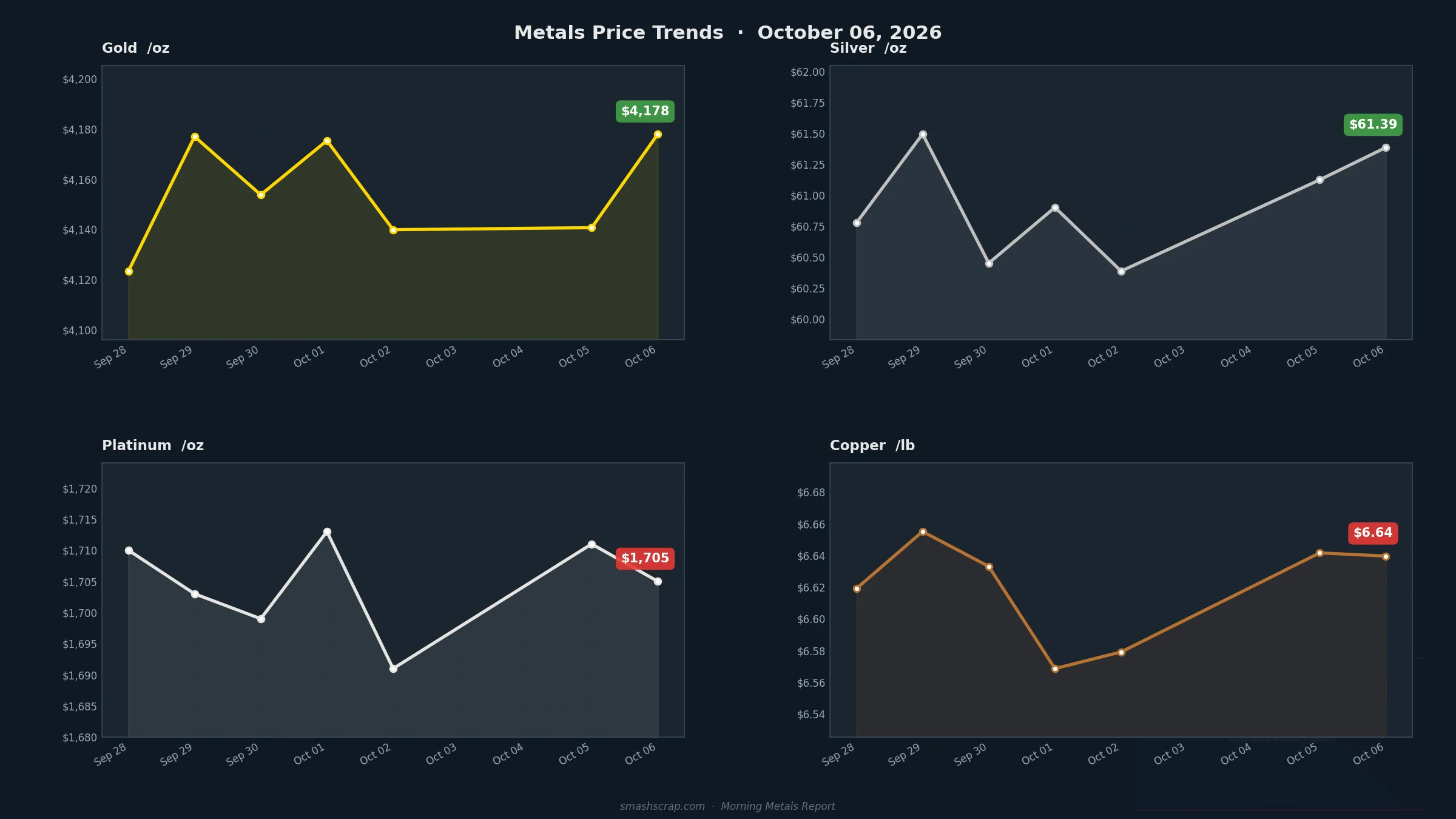
Gold closed Friday near $4,661/oz — up roughly 5% on the week — driven by a weaker U.S. dollar, Treasury buyback headlines, and growing expectations that the Fed holds rates steady through the fall. Wall Street is running out of bears. When Kitco reports that Main Street is now majority bullish on gold alongside institutional money, that's not a footnote — that's a signal.
Silver is the louder story, though. Up 20% in August alone, silver is being dragged higher by gold's momentum and its own supply dynamics. The $100/oz target is being floated openly. Whether it gets there or not, the move is real enough to affect scrap pricing on non-ferrous material containing silver-bearing components, including certain electronics and industrial catalysts. Don't price this week's loads off last month's numbers.
For yard operators running catalytic converter inventory, precious metal prices are the heartbeat of your converter values. Platinum group metals (PGMs) — platinum, palladium, rhodium — are priced separately from gold and silver, but they move in the same macro current. When gold runs, the broader precious metals complex tends to get re-rated. Pay attention. If you're sitting on a load of cats and haven't checked PGM spot this week, check before you quote anything. A catalytic converter auction format — like what SMASH runs — gives you live competitive bids rather than one buyer's offer on a down day.
Disclaimer: Metal prices fluctuate daily. Always verify current spot rates before pricing any load.
Copper and Aluminium: Geopolitics Is Now a Pricing Input
Copper is up approximately 9% since the Iran war escalated and is approaching its January 2026 peak. Two forces are driving it: supply-side disruption risk from the Middle East, and the growing narrative that copper is a strategic commodity for the AI era — data centers, EV infrastructure, grid buildout. That second narrative has legs regardless of geopolitical news flow.
LME copper inventories did tick higher this week, and cash-to-three-month spreads narrowed slightly — signs that near-term physical tightness may be easing. But price stayed firm. That disconnect between loosening near-term supply and sustained high prices tells you the market is pricing something longer-term. For scrap yards moving #1 copper, bare bright, or insulated wire, the spread between scrap and LME is your margin. Tighter LME cash spreads could pressure that spread — worth watching into next week.
Aluminium had its own supply shock this week. QatarEnergy halted metal output at Qatalum — the Qatar-based aluminium smelter — citing disruptions tied to the broader Iran war. Qatalum is a meaningful producer. Losing even partial output from a facility that size moves the market. Aluminium scrap — extrusions, cast, MLC, Taint Tabor — all respond to primary aluminium pricing. If primary stays elevated, secondary scrap commands better spreads. Watch LME aluminium next week for follow-through or correction.
U.S.-Canada Tariff Escalation: What It Means for Steel Scrap in Michigan
This one hits close to home — literally — if you operate in Detroit or anywhere in Michigan. Canada announced it will impose retaliatory tariffs starting September 8 on U.S. steel, electronics, dairy, appliances, agricultural equipment, and other goods, following Trump's 50% tariffs on Canadian imports. This is no longer hypothetical trade friction. It has a start date.
For ferrous scrap, the ripple effects are real:
- Cross-border flows tighten. Michigan yards that historically moved material across the Ontario border — or bought from Canadian dealers — now face a more complicated cost structure on both sides.
- Domestic steel demand signals get murkier. If Canadian steel faces retaliatory pressure and U.S. mills absorb more domestic scrap to compensate, that could support HMS and shredded pricing. Or, if construction and manufacturing sentiment softens on tariff uncertainty, demand drops. Both outcomes are plausible right now.
- September 8 is the date to mark. Anything moving across the U.S.-Canada border in ferrous or steel-adjacent categories before that date is operating under a different cost structure than what follows.
The old way of handling this uncertainty is to call your one buyer, guess at the impact, and hope for the best. The SMASH way is to put your load in front of multiple industrial scrap metal buyers simultaneously and let competition sort out what the market actually thinks your material is worth right now — not what one buyer's margin target says it's worth. More buyers means better price discovery. That's not a slogan. That's just math.
If you want to stay current on how tariff moves are reshaping scrap flows in the Midwest and beyond, read the latest scrap industry news on the SMASH blog — we cover the market moves that matter to your yard, not just headlines from financial desks.
What to Watch the Week of August 24–30, 2026
Next week has several market-moving events lined up. Here's your watchlist:
- PCE Inflation Data — The Fed's preferred inflation gauge drops next week. If PCE comes in hot, rate-cut expectations get pushed out and gold could give back some of its gains. If it comes in tame, the dollar softens further and precious metals likely hold or push higher. Either way, it moves PGM-adjacent scrap values.
- Jackson Hole Commentary — Fed officials are speaking at Jackson Hole. Markets will parse every word for signals on September policy. This affects the dollar, which affects every commodity priced in USD.
- September 8 Tariff Deadline — Canadian retaliatory tariffs on U.S. steel kick in. If you have cross-border deals in motion, you have roughly two weeks to close them under current terms. Act accordingly.
- Aluminium Supply Follow-Through — Watch whether the Qatalum disruption deepens or stabilizes. A prolonged outage is bullish for aluminium scrap. A quick resolution could mean this week's price move partially reverses.
- Copper Inventory Data — LME weekly inventory updates will tell you whether the near-term easing in copper tightness continues or reverses. Tight inventories support price; rising stocks soften it.
If you operate a yard in Detroit or anywhere across Michigan, next week is not a week to be passive. Price discovery matters more when markets are moving fast. Put your loads in front of vetted buyers. Let the bids tell you where the market is.
Scrapping a Vehicle? Don't Leave Value Behind
With precious metal prices running hot and non-ferrous markets showing strength, the value embedded in end-of-life vehicles is higher than it's been in recent memory. If you're helping customers dispose of vehicles — or have fleet units cycling out — make sure you're capturing the full picture: the cat, the non-ferrous, and the steel body weight.
For end-of-life vehicle disposal, getmyscrapcar.com is a straightforward resource for sellers looking to understand what their scrap vehicle is worth in the current market. And for the converter inventory that comes off those vehicles, a catalytic converter auction through SMASH puts your cats in front of multiple qualified buyers — not one buyer with a lowball offer and a lot of confidence.
No subscription fees. No lock-in. SMASH only wins when you win.
The SMASH View: What This Week Tells Sellers
Here's the plain read on this week for anyone selling scrap: markets are moving fast, in multiple directions, for multiple reasons at once. Precious metals are running. Copper is strong on geopolitical supply risk. Aluminium got a shock. Ferrous sentiment is clouded by tariff uncertainty that hasn't fully resolved.
In a market this fluid, the worst thing you can do is rely on a single buyer's quote as your price discovery mechanism. One phone call to one buyer, in a week like this, is leaving money on the table — or worse, locking in a price right before a move in your favor.
When you explore the SMASH scrap metal marketplace, you're putting your inventory — whether it's non-ferrous, cats, cores, or a mixed industrial load — in front of vetted buyers who compete. Photo documentation, serial tracking, VIN lookup for automotive material, auto-invoicing. The infrastructure is built for yards that are serious about running their book right.
Whether you're in Detroit, across Michigan, or anywhere in North America, the platform works the same way: competition, transparency, and no guessing.
Want to know how sell steel scrap online through a competitive auction format? Register at smashscrap.com — no subscription, no setup fees, just your loads and buyers who want them.
Frequently Asked Questions
Q: What is a scrap metal auction online and how does it work?
A scrap metal auction online is a digital platform where sellers list their scrap inventory — non-ferrous, ferrous, catalytic converters, industrial material — and vetted buyers place competitive bids. SMASH runs this format with photo documentation, serial tracking, and auto-invoicing built in. You get real price discovery instead of a single buyer's quote.
Q: How do U.S.-Canada tariffs affect scrap metal prices in Detroit and Michigan?
Tariffs on Canadian steel and U.S. retaliatory measures can affect cross-border scrap flows, domestic mill demand, and spreads between grades. Michigan yards sit close to the Canadian border, so trade friction here is more than abstract — it affects who your buyers are and what they'll pay. Competitive auctions help surface real market pricing when sentiment is mixed.
Q: Does a catalytic converter auction get better prices than selling to one buyer?
Competition tends to improve price discovery. When multiple buyers bid on your converter load simultaneously, you see what the market actually values your material at — not what one buyer's margin target allows. SMASH runs catalytic converter auctions with vetted buyers and documented inventory to give buyers the confidence to bid aggressively.
Q: Are there subscription fees to list scrap on SMASH?
No. SMASH does not charge subscription fees. The platform is structured so that SMASH only earns when a sale is completed. You can list your inventory and see what the market offers without a monthly cost.
Q: How does the scrap metal auction Michigan market compare to broader U.S. markets?
Michigan — especially the Detroit metro — has deep industrial roots in automotive and manufacturing, which drives strong volumes in non-ferrous, catalytic converters, and ferrous grades. Pricing generally tracks LME and regional mill indices, but local supply-demand and proximity to the Canadian border add their own dynamics. Using an online auction platform connects Michigan yards to buyers beyond their local market, which broadens competition and improves price discovery.
List your scrap on SMASH today — register for free at smashscrap.com. No subscription. No guessing. Just competition.
Stay current on scrap markets and industry news — follow SMASH on LinkedIn for weekly market insights and scrap metal industry updates.
```